The Farthest Shore
Earthsea, Book 3
Ursula K. Le Guin
★★★★☆
Magic is failing, and a young prince sails the islands with Ged, now older and the Archmage of Earthsea, to seek the cause and resolve the crisis…if it can be resolved.
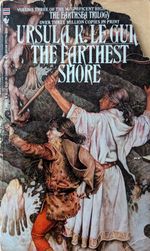
But it’s still quite good (I rated it four stars, after all!), and this time through I appreciated it a lot more than on previous reads. Maybe it’s that I’m more familiar with depression than I was at twelve. Maybe it’s that I’m closer to Sparrowhawk’s age. Or maybe I’m just seeing more connections, now that I’ve read more of Le Guin’s work.
And there’s so much in this one! The people who live on huge rafts, following the ocean currents. Speaking with dragons. Journeying through the land of the dead. Ged being literally the most appropriate person to undo the damage that has been done, not because of the strength of his magic (which is necessary, but not sufficient), but because of what he did and learned in the first novel: The willingness to temper his ambition with full acceptance of who he is.
And this exchange, which has stuck in my head for years:
“The first lesson on Roke, and the last, is: Do what is needful. And no more!”
“The lessons in between, then, must consist in learning what is needful.”
“They do.”
In the first book, we see Ged’s thirst for knowledge and power lead him astray. By this time he’s gained real wisdom, and it’s that wisdom that can save the archipelago.
It’s a fitting capstone on the trilogy, and the heroic phase of Ged’s life. And I can see why some readers would want to stop there. But I think it benefits from the perspective gained in the later books.
More info at The Farthest Shore.